So why did the caulkers union hold these events? And how did they fit into the larger trend of steamboat excursions in Baltimore? To understand the caulkers’ excursions, we need to look at the rise of the pleasure excursion in nineteenth-century Baltimore.
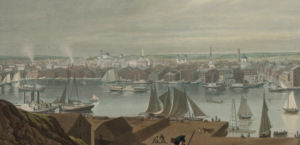
Steamboats in Baltimore’s Inner Harbor, 1831 (Bennett 1831)
“HEALTH AND PLEASURE.—These two great objects of existence, and contributors to happiness, are always to be found combined in aquatic excursions; more especially in places like our beautiful bay, where sea, earth and sky combine so intimately, and blend their beauties so felicitously, to lend enchantment to utility. Those who desire such enjoyment are referred to the advertisement in another column headed “pleasure excursion.” This afternoon, at four o’clock, all who board the steamer Columbia at the foot of Commerce street, will be enabled to test our views of aquatic excursions” (Baltimore Sun 1840).
Steamboats had been around since the late eighteenth century, but they were not commercially viable in the United States until the first decades of the nineteenth century. Early on, steamboats were a volatile form of transportation, with boiler explosions and fires claiming the lives of passengers. The success of early steamers in the United States owes more to the lack of good roads than the safety of the boats. Compared to other areas, the Chesapeake Bay had relatively few steamboat disasters or accidents (Brown 1961, 16).
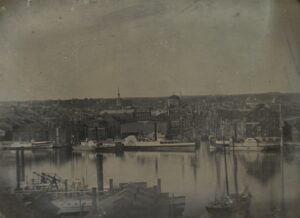
View of the Gay Street Dock from Federal Hill, showing steamboats Herald and Juanita, ca. 1843-1850 (Clark ca.1843-50)
The first pleasure excursions on the Chesapeake were held in the 1810s, but it was not until the 1840s that their popularity boomed in Baltimore. For comparison, newspapers in the 1820s and 1830s would have the occasional advertisement for a steamboat excursion, but by the late 1840s, it was common for at least one column in the newspaper to be filled with ads for excursions during the summer months. The pinnacle of the pleasure excursion season appears to have been the 4th of July, when Baltimoreans could choose from dozens of steamboat tours. The invention of better, safer boilers as well as the creation of the U.S. Steamboat Inspection Service in 1838 helped fuel an explosion in steamboat excursion popularity, rather than explosions of the more literal kind (Brown 1861, 16).
These excursions were first held by the steamboat companies themselves, but soon other organizations and companies began hosting trips, too. Starting in 1841, independent parties chartered steamboats for their own excursions. One of the first was held by the Independent Greys, a volunteer militia with their own band. It was advertised as a cotillion (a large formal event or ball) with the Independent Grays Band and Murray’s Cotillion Music (Baltimore Clipper 1841). The number of this type of excursion soon grew, with excursions held by fire companies, hotels, and church Sunday schools.
Excursions organized by the caulkers and other Black community organizations gave Black Baltimoreans opportunities to enjoy summer outings on the water. Although surviving advertisements do not explicitly state that Black passengers were excluded from attending trips held by White groups or businesses, racial norms likely limited their access or shaped their experiences aboard them. Black-organized excursions offered something more: an opportunity to enjoy a day of recreation among friends, family, and neighbors, with greater freedom from the prejudice or hostility they might encounter in other public spaces.
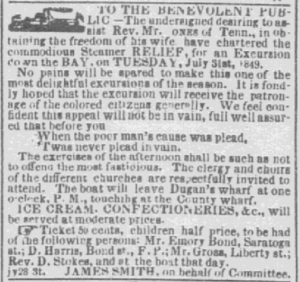
Advertisement for excursion to aid Rev. Mr. Ones of Tennessee to purchase the freedom of his wife (Baltimore Sun 1849c)
As fundraisers, these events also allowed community members to financially support each other. One especially poignant example is an excursion on July 31, 1849, held to “assist the Rev. Mr. Ones of Tenn., in obtaining the freedom of his wife….” While food would be offered, the entertainment for this cruise was more reserved, “such as not to offend the most fastidious. The clergy and choirs of the different churches are respectfully invited to attend” (Baltimore Sun 1849c).
The individual ticket price of the caulkers union pleasure excursions was $.50 or half price for children. Interestingly, most of the advertisements do not specifically refer to the caulkers as “colored” or “negro,” as would have been the convention of the time. The advertisements were taken out by the caulkers themselves and, as in other instances, the lack of need to specify their race is indicative of the monopoly they held on their trade and the general understanding among Baltimoreans that caulkers were Black. That these excursions were held by Black caulkers is confirmed by the familiar names of union presidents and committee members: Israel Jones, Samuel Dorrity, James Lomax, and John Locks.
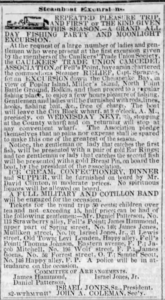
Baltimore Sun advertisement for the caulkers’ September 1846 excursion (Baltimore Sun 1846b)
The caulker-sponsored boat excursions were not small events. Some lasted from morning until late into the evening and included supper, ice cream, and “confectionery” (at reasonable prices), and a band. One of the first excursions, in September 1846, traveled down the Chesapeake within view of Poplar Island, Miller’s Island, North Point Battle Ground, and Bodkin Island to a fishing place where those onboard could enjoy a few hours of fishing with rods, lines, hooks, and fishing bait provided at no charge. The first person to catch a fish would receive a pair of gold earrings, while the second would receive a gold breast pin and both would be presented by the president of the of caulkers trade union who, at that time, was Israel Jones (Baltimore Sun 1846b).
Most of the events were held on the steamboat Relief, about which there is little information recorded. The first mention of the ship was made in 1833 (Baltimore Gazette & Daily Advertiser 1833). The August 1847 excursion was held on the steamboat Pocahantas. The ad for this trip boasted that there was “ample accommodation for dancing, & etc., which cannot be excelled by any boat on the river.” Additionally, there would be “two transparent splendid Balloons sent up from on board the boat at 9 o’clock at night, as the boat is returning up the bay” (Baltimore Sun 1847b).
A contemporary description of the Pocahantas helps us picture the setting for these festivities. Constructed in Baltimore in 1829-30 by the Maryland and Virginia Steam Boat Company (Brown 1961, 160), the Pocahantas was acquired by Powhatan Steamboat Company in 1845 and used for trips between Baltimore and Richmond. Designed specifically for passenger service, the vessel offered considerably more than simple transportation:
“She is in all respects a boat of the first class, and being intended exclusively for the transportation of passengers, combines the most improved arrangements, as well as on the score of elegance as comfort…. The principal cabin or dining room is below deck, it is a spacious, light and airy apartment, handsomely finished and furnished, and contains thirty-two commodious births [sic]. One hundred persons may here be accommodated at table…. An upper deck, the loftiness of which affords abundance of light and free circulation of air to the main deck and lower cabins, extends the extreme length and width of the boat, and presents a safe and delightful promenade of the most ample dimensions” (as quoted in Brown 1961, 17).
That expansive upper deck, extending the full length and width of the boat, helps make sense of the advertisement’s promise of ample room for dancing. It would also have provided excursion-goers with plenty of space to gather and watch the balloons rise from the boat as it returned up the bay that evening. No known images of the Pocahantas survive, so we used AI to create a rendering based on the vessel’s reported dimensions, this contemporary description, and images of steamboats in Baltimore during the 1830s. These early steamboats were smaller and lower than the multi-deck vessels that became common later in the century.
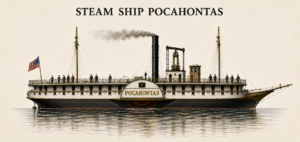
AI rendering of the steamboat Pocahantas based on a contemporary description, recorded dimensions, and other steamships build around the same time.
The excursions offered entertainment, but they also served a larger purpose for the Caulkers Union. Advertisements for later excursions indicate that at least some of the events raised money for the caulkers’ union hall. Because earlier advertisements do not mention fundraising, we do not know when that effort began. We do know that the fundraising was successful: by January 1850, the hall had been constructed on the 500 block of Dallas Street, where a “grand fair” was held that month (Baltimore Sun 1850). The building stood on the same block as Strawberry Alley Church, which many of the caulkers attended.
For Fell’s Point’s Black caulkers, then, a summer day on the Chesapeake was about more than escaping the heat. These excursions offered a chance to dance, fish, eat, listen to music, and simply enjoy time on the water with family, friends, and neighbors. At the same time, the money spent on a fifty-cent ticket could help support a community member in need or contribute to the cost of building a union hall of their own.
Nearly two centuries later, the pull of the water on a hot Baltimore summer day is still easy to understand. Baltimoreans still head for the water when summer arrives, looking for a chance to get out on the water and escape the routines of everyday life. The boats and scenery may look different, but the reasons for going have changed little. Like Baltimoreans today, Israel Jones, Samuel Dorrity, James Lomax, and the other caulkers who boarded the Relief or Pocahantas could spend a summer day on the Chesapeake surrounded by good company and away from the routines of everyday life.
References
American and Commercial Daily Advertiser. 1840. “Pleasure Excursion.” 1 June 1840. Page 2. Genealogybank.com.
Baltimore Clipper. 1841. “Cotilion & Pleasure Excursion” 26 June 1841. Page 3. Genealogybank.com.
Baltimore Gazette & Daily Advertiser. 1833. “Marine List. Port of Baltimore.” 18 February 1833. Page 3. Genealogybank.com.
Baltimore Sun (Baltimore, MD).
-----. 1840. “Health and Pleasure. 4 June 1840. Page 2. Genealogybank.com.
-----. 1846a. “Grand Afternoon and Moonlight Excursion Down the Patapsco and Millers Island.” 11 August 1846. Page 3. Newspapers.com.
-----. 1846b. “Repeated Pleasure Trip and First of the Kind Given This Season.-A Grand All Day Fishing Party and Moonlight Excursion. 8 September 1846. Page 3. Newspapers.com.
-----. 1847b. “The Grand Annual Afternoon and Moonglight Excursion of the Caulkers.” 17 August 1847. Page 2. Newspapers.com.
-----. 1847c. “Grand Prize Excursion to Poo’s Island, on Tuesday, September 7th.” 6 September 1847. Page 3. Newspapers.com.
-----. 1849a. “Grand Excursion.” 7 July 1849. Page 3. Newspapers.com.
-----. 1849b. “Steamboat Excursions. 10 July 1849. Page 2. Newspapers.com
-----. 1849c. “An Excursion.” 28 July 1849. Page 3. Newspapers.com.
-----. 1850. “There will be a grand fair…” 1 January 1850. Page 2. Newspapers.com.
-----. 1851. “Caulkers’ Grand Afternoon and Moonlight Excursion to Rock Creek.” 10 July 1851. Page 3. Newspapers.com.
Bennett, W.J. 1831. “Baltimore from Federal Hill / paind. & engd. by W.J. Bennett.” New York: Pub. by H.I. Megarey, printed by J. & G. Neale at Illman and Pilbrows. https://www.loc.gov/item/98504708/.
Brown, Alexander Crosby. 1961. “Steam Packets of the Chesapeake: A History of the Old Bay Line Since 1840.” Tidewater Publishers. https://archive.org/details/steampacketsonch00brow/page/n5/mode/2up.
Clark, Henry H. ca. 1843-1850. “Gay Street dock, northeast from Federal Hill.” Image courtesy of the Maryland Center for History and Culture, Baltimore, MD. Resource ID 17707. https://www.mdhistory.org/resources/gay-street-dock-northeast-from-federal-hill/.

