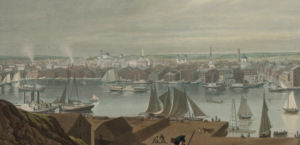

1844-50 daguerrotype by Henry H. Clark is one of the earliest photographs of Baltimore, showing a view southeast from the Pheonix Shot Tower that includes Fell’s Point and its shipyards on the right side of the image (MCHCca. 1868 view of the Chesapeake Marine Railway, the joint-stock company started by Black ship caulkers after strikes forced them out of Fell’s Point’s shipyards.
Have you ever thought about the difference between the “past” and “history”? In our everyday lives, we often use the two words interchangeably. But they have two distinct meanings to historians: the past refers to everything that has happened before now, while history is how the past is interpreted. The past is unalterable; history changes. New information, new perspectives, and new emphases on marginalized groups changes how we understand past and how it is interpreted.
For centuries and millennia, history has focused on a very narrow sliver of the population, white men. In Fell’s Point, for example, the historical narrative has primarily focused on white male shipbuilders and privateers and disregarded women, African Americans, and the many other ethnic groups that have contributed to what it is today. Marginalized populations were just that, always at the periphery of history—supporting characters at best. As these groups are centered, we can and should understand the past differently. Our small part in this endeavor, uncovering and telling the history of Baltimore’s Black ship caulkers, demonstrates the challenges of telling these stories. Many of the caulkers are listed only in a directory or census record, but how many were passed over by census-recorders or missed by directories?
But sometimes, as In Dorrity’s case, we have a comparative treasure-trove of information that has been overlooked. So, what are the facts presented by the historical record that we have uncovered to-date, of these last years of Dorrity’s life?
- The 1860 U.S. census finds Samuel in San Francisco with five other Black caulkers, and one white washer, from Baltimore (Ancestry.com).
- In 1863 Samuel was back in Baltimore and owned a schooner, the J.J. Barrel, which he captained and sailed to port cities such as Philadelphia, Hampton Roads, and Alexandria (Philadelphia Inquirer, 1864).
- During the early 1860s Dorrity oversaw the J.J. Abrahams & Son screwdock and had “absolute control” (New National Era, 1871).
- Captained pleasure excursions, such as one on the steamer Phoenix on June 26, 1865 (Baltimore Sun, 1865b)
- Dorrity was among the ship caulkers listed as grantees in the 1866 deed subleasing land on which the Chesapeake Marine Railway would operate (Baltimore City Deed Book AM 295:299, 1866)
- As superintendent of the yard, Dorrity was listed in a classified ads for the sale of canal boats and schooners constructed at the Chesapeake Marine Railway (Baltimore Sun, 4 October 1866; Baltimore Sun, 1870)
- He signed a petition presented to the Baltimore Public School Board, asking for Black teachers in Baltimore’s schools (Baltimore American, 1870)
- The 1870 census showed Dorrity had $4,000 in real estate and $1,000 in personal property (Ancestry.com).
- Samuel Dorrity’s will left houses to his daughters and wife, deeded money to the Dallas Street and Union Bethel churches, provided a horse for his brother, and gave his stock in the Chesapeake Marine Railway to his three daughters (BCWB JHB 37:257, 1871).
The historical record present us with a fascinating picture of a man who was involved in multiple enterprises simultaneously. A ship caulker, ship captain and owner, and shipyard superintendent/foreman who was involved in his community.

Bird’s Eye View of San Francisco in 1860, the year Dorrity and other Baltimore caulkers were working in the city’s shipyards (Map of the State of California, 1860)
The questions these records raise are even more fascinating. How did he and other caulkers from his community end up in San Francisco in 1860? In his New National Era newspaper article from July 6, 1871, Frederick Douglass mentions caulkers he knew who left Baltimore to live in California, Oregon, Canada, or even South America (New National Era, 1871). Research into other caulkers during this period show them working at the Washington, D.C. Navy Yard or working in New York (Naval History and Heritage Command 2020; Ancestry.com). Clearly their skills as caulkers provided them the opportunities to live and work in other cities, particularly during periods of time when work in Baltimore may have been hard to find. This journey to San Francisco came shortly after the 1858 Caulkers’ Riots, during which white gangs of workers used violence and intimidation to break the Black caulkers’ monopoly and take over caulking work at shipyards in Federal Hill. While Black caulkers continued to be employed at Fell’s Point’s shipyards, the number of jobs for Baltimore’s Black caulkers would have decreased.
The prospects of work in San Francisco must have been lucrative enough for this contingent of Baltimore caulkers to make the journey. San Francisco was booming and had many shipyards which built and repaired ships. And Baltimore’s caulkers’ international reputation (as noted in multiple contemporary newspaper articles) could have proceeded them. But journeys to California could take four to six months if sailing via Cape Horn, or about one month if traveling via steamship to Panama, then crossing the isthmus via railroad and catching another steamer to San Francisco.
Samuel Dorrity is only referred to as a ship captain after his return from California; did he learn how to sail a ship during his voyages to San Francisco and back? By 1863 he owned the J.J. Barrel, when in May his boat was seized by Baltimore Constables. Maryland law required that all vessels sailing in its waters have a white person on board, and Dorrity was violating that law. But his vessel was released because he had a certificate from the Baltimore Customs House that “the [U.S.] Secretary of the Treasury had granted permission to [Dorrity] to sail his vessel in the waters of Maryland” (Baltimore Sun 1863). However he received that permission (a story we would love to know!), by the end of his life he was successful enough that his will listed half ownership of the J.J. Barrel and full ownership of a second schooner, the Monterrey (Baltimore City Will Book [BCWB] JHB 37:257, 1871).

1870 View of from Federal Hill, looking east toward Fell’s Point (Library of Congress).
Somehow, Dorrity had time to do even more. Frederick Douglass’s 1871 New National Era article states that he oversaw screw dock owned by John Abrahams (where boats were repaired) in Fell’s Point. While Douglass doesn’t give a time frame, some additional facts allow us to piece together the timing. Black caulkers continued to hold most caulking jobs in Fell’s Point through the end of the Civil War, but in the fall of 1865 the white ship carpenters of Fell’s Points shipyards went on strike, with demands that white foremen be hired in the shipyards and that preference be given to white workers (Baltimore Sun, 1865). The specific shipyard mentioned as not giving in to the demands of the white carpenters? It was none other than J.J. Abrahams & Sons, the same yard of which Dorrity was foreman (Baltimore Sun, 1865c). Ultimately, the strike ended with an agreement that the shipyards would choose their foreman, but that Black caulkers would be gradually replaced with white ones “until a sufficient number [was] furnished” (Baltimore Sun, 1865d).
It is unclear whether, for exactly how long, Dorrity remained foreman of J.J. Abraham & Sons screw dock after the strike ended. He may have left the screw dock when all Black caulkers quit working at the shipyards two weeks after the agreement was reached. He was one of the leaders of the new joint-stock company that would eventually become the Chesapeake Marine Railway; his name on the sub-lease of the shipyard on Philpot Street from William Applegarth. The Black men were not allowed to buy or lease the land directly, so it had to be sub-leased from a white businessman.
The Chesapeake Marine Railway was formally incorporated in 1868, but work at the yard began in 1866, as evidenced by 1866 advertisement for the sale of a canal boat at the yard. Dorrity served as superintendent of the yard from 1866 at least through 1868, and probably longer since Dorrity continued to be listed as the contact for boats constructed by the Chesapeake Marine Railway (Baltimore Sun 1866, 1870).

1870 Baltimore Sun advertisement for a schooner constructed at the Chesapeake Marine Railway (Baltimore Sun, 1870).
And somehow, he found time to be civic minded and push for Black rights in Baltimore, such as the petition he signed for Black teachers to be hired for Baltimore city schools. Or to host the meeting after Abraham Lincoln’s assassination, resolving to fight for the federal government and to protect their new freedom from slavery, even before the 14thAmendment granted African Americans citizenship (Baltimore Sun 1865a).
So far, research has not uncovered how or the exact date of Samuel Dorrity’s death. He signed his will on January 23, 1871, at which point he was described as “sick and weak of body” (BCWB JHB 37:257, 1871). We don’t know how long he was ill, but died sometime before the will was recorded on May 19, 1971. That date fell just a few days after the 31stanniversary of his freedom, May 15.
There’s so much more research to be done and likely too much that we will never know about Samuel’s life. The decades that he was enslaved, his family connections, and the multitude of moments not recorded. But even the little we know indicates a remarkable life. The extent to which he was successful in no way diminishes the overwhelming challenge of living and working in a society entrenched in systematic and institutional racism. Rather, it raises the question of what he would have achieved without those impediments. Frederick Douglass gave his answer to that question in his praise of Dorrity:
Had he been a white man, or had he been given anything like fair play, he would have been one of the most successful men Baltimore ever knew.” (New National Era, July 6, 1871).
References
Ancestry.com. United States Federal Census [database on-line]. Provo, UT, USA: Ancestry.com Operations, Inc. 2012.
Baltimore American. 1870. “Appointment of Colored Teachers—Memorial of Colored Citizens.” March 2, 1870. Page 4.
Baltimore Sun (Baltimore, MD).
------. 1863. “The Law Nugatory.” May 13, 1863. Page 1. Newspapers.com.
------. 1865a. “At a Mass Meeting of the Colored People of Baltimore.” April 18, 1865. Page 2. Newspapers.com.
------.1865b. “Notice. The First Colored Excursion of the Season will be Given on Monday Afternoon Next.” June 22, 1865. Page 2. Newspapers.com.
------. 1865c. “The Strike on Negro Caulkers.” September 30, 1865. Page 2. Newspapers.com.
------. 1865d. “The Strike at an End.” October 28, 1865. Newspapers.com.
------. 1866. “For Sale.” October 4, 1866. Page 2. Newspapers.com.
------. 1870. “For Sale.” February 25, 1870. Page 2. Newspapers.com.
Naval History and Heritage Command. 2020. “The Diary of Michael Shiner, Entries from 1831-1839.” Published November 14, 2020. https://www.history.navy.mil/research/library/online-reading-room/title-list-alphabetically/d/diary-of-michael-shiner/1831-1839.html
New National Era (Washington, DC). 1871. “The Editor’s Visit to the Old Ship-Yard in Baltimore. July 6, 1971. Page 2. Newspapers.com.
Philadelphia Inquirer. 1864. “Cleared Yesterday.” June 16, 1864. Page 7. Newspapers.com.