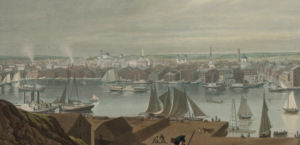

1844-50 daguerrotype by Henry H. Clark is one of the earliest photographs of Baltimore, showing a view southeast from the Pheonix Shot Tower that includes Fell’s Point and its shipyards on the right side of the image (MCHC, Object ID CSPH 665).
In October, the Friends Group participated in the Homewood Museum Architecture Lecture. Rather than making life easier for myself, I decided to undertake new research on a caulker named Samuel Dorrity (whose name appears variously as Dorrity, Dority, and occasionally Dougherty). He came with a glowing recommendation from Frederick Douglass himself, who described Dorrity as,
“…a man who, despite of slavery—despite all manner of combinations against him—made himself highly respected…. He was one of our secret night-school scholars—for we were not allowed to teach openly. Captain Dougherty, as he was called, was one of the most energetic and enterprising men in Baltimore. Had he been a white man, or had he been given anything like fair play, he would have been one of the most successful men Baltimore ever knew” (New National Era,6 July 1871).
Born enslaved in 1812 and raised in Baltimore City, we know little about Dorrity’s early life or family. His half brother, Jeremiah Chester, was also a ship caulker, but was born free ca. 1816 and raised in Talbot County (Baltimore County Court Certificates of Freedom, 1830-32; Baltimore City Will Book JHB 37:257, 1871). Since the legal status of a Black child was determined by their mother’s status, it appears that Samuel and Jeremiah shared a father but did not have the same mother.
Though we don’t know their father’s name, he may also have been a ship caulker, or worked in another shipbuilding trade, since these skills were frequently passed from father to son. In the late eighteenth and early nineteenth centuries, enslavers brought enslaved people to Baltimore to learn skilled trades as agriculture declined in profitability elsewhere in Maryland. Some were eventually permitted to purchase their freedom or were manumitted after years of productive labor. (Phillips 1997, 7-29, 158).
Samuel Dorrity gained his freedom on May 15, 1840 and was manumitted by Angelo Atkinson (Baltimore County Court Certificates of Freedom, 1832-41). Whether he purchased his freedom or secured it through an agreement with his enslaver, at 26 he entered a new phase of his life and, as Frederick Douglass described him, “energetically” embraced his new freedom.

Samuel Dorrity’s certificate of freedom, issued one day after his manumission. The certificate reads, “On the 16 day of May 1840, before me clerk of Balto. County Court personally appears Mary Howard & makes oath in due form of law that Samuel Dority aged about 28 years , of dark complexion, 5 feet 7 inches high, has a small burn scar on the left arm above the elbow, is the identical person manumitted by Angelo Atkinson on the 15 day of May 1840 & recorded in Liber T.K. No. 61, folio – one of the records of Baltimore County Court; and that said Samuel Dority was raised in Balto City” (Baltimore County Court Certificates of Freedom, 1832-41).
Before he was freed, sometime between 1836 and 1838, Samuel was one of the members of Frederick Douglass’s night school classes. Douglass wrote about the classes:
My first effort in instructing colored people was commenced here. I opened a night school on Wolfe Street, and afterward one on what was then called Fleet Street. Both were well attended and I found my work profitable and pleasing. My own ability was limited, and I could not carry my pupils very far. I could read and write and cipher a little, but this little was freely imparted to those who gathered about me anxious to learn and to improve” (Baltimore Sun 1891).
Teacher and student, both still enslaved, were risking their freedom by participating in these classes. But education and literacy were important to Black Baltimoreans, and important enough to Douglass and Dorrity to take this risk. Throughout Baltimore, Black communities established schools for their children. The Strawberry Alley Church in Fell’s Point, located on the 500 block of south Dallas Street, started a Sunday School in 1830. Frederick Douglass talked about attending the meeting celebrating the first anniversary of the Sunday School and recounted that it was “the first time he ever saw a colored man with manuscript before him. It did him good to see a black man… display so much learning, and he went away with a higher opinion of the possibilities for and capacity of his race than he ever had before. It gave him confidence and hope for the future.” (Baltimore Sun 1879).
Both Douglass and Dorrity were born enslaved and both gained their freedom. Dorrity obtained his freedom through legal means, whereas Douglass escaped to the north to gain his. While Douglass left Baltimore and became internationally known for his memoirs, essays, and oratory, Dorrity stayed in Baltimore and lived and worked within the constraints of an antebellum slave state. He also found ways to work around or through these constraints, as did other Black ship caulkers and African Americans who lived in Baltimore during this era.
Evidence of Dorrity’s enterprising nature was immediate. In 1841, just one year after gaining his freedom, Dorrity purchased property at what is now 512 S Dallas Street under a 99-year leasehold, an arrangement similar to a ground lease that could be renewed, inherited, or assigned so long as the annual payment was made (Baltimore County Deed Book TK 309:378, 1841). While this lowered the barrier to property acquisition, failure to pay meant forfeiture.

Samuel Dorrity purchased a leasehold on this house at 512 S Dallas Street in 1841.
Over the next decades, Samuel acquired additional leasehold properties: at 509 S Bethel (no longer extant) in 1849 and 506-508 S Bethel Street in1854 (Baltimore County Deed Book AWB 411:186, 1849; Baltimore City Deed Book ED 60:3, 1854). In 1855 he made a fee-simple purchase of a house at 1714 Mullikin Street (no longer extant) (Baltimore City Deed Book ED 87:466, 1855). He lived at 506 S Bethel after its purchase in 1854 and the remainder were rental properties and/or housed family members.

Locations of houses owned by Samuel Dorrity, shown on an 1851 Plan of the city of Baltimore (Library of Congress)
Samuel was married to Louisa Francis (born ca. 1812). While their marriage date is unknown, their oldest daughter Mary A. Dorrity was born in 1840. Two additional daughters were included in his will: Catherine (born 1843) and Charlotte Frances (born 1848). Samuel and Louisa were separated in 1848 (Baltimore Sun 1848b) and the two were not listed together in census records after that date, and filed for divorce in 1868 (Baltimore American 1868). Though separated, the house Samuel purchased in 1855 on 1714 Mullikin Street was purchased for Louisa and she lived there until his death. And while he left the house to her in his will, Louisa formally renounced all claims to his estate (Baltimore City Will Book JHB 37:257, 1871).
Throughout his life, Samuel was involved in the activities of the Caulkers Trade Union Society. In 1846, Dorrity served as one of seven managers of a Caulkers Trade Union Society excursion to Miller’s Island, complete with a military and Cotillion Band, refreshments, and notably no “spirituous liquors” (Baltimore Sun 1846a). The caulkers sponsored many such excursions throughout the 1840s and 1850s, as fundraisers for their trade union. Dorrity also participated in a similar excursion to benefit the “Public School of Color” in 1846 (Baltimore Sun 1846b).
Another example of Samuel’s role in his community was his part in organizing a meeting held on January 22, 1852, to find ways to improve the living conditions of the poor. In addition to Dorrity, organizers included Daniel Keith, John A. Fernandis, and James Morris (Baltimore Sun 1852). Caulkers earned $1.50 a day, significantly more than many unskilled laborers, and pooled resources to support members facing illness, injury, or unemployment (Baltimore Sun 1858). Even Dorrity appeared in 1848 among applicants for insolvency benefits, a reminder that economic security was never guaranteed (Baltimore Sun 1848a).
By the end of the 1850s, Samuel Dorrity had secured his freedom, invested in property, and assumed leadership within his community. Yet the records we have traced thus far reveal only the first part of this story. His work would take him across the continent to San Francisco, before returning to Baltimore to rise to positions of greater responsibility in the ship caulkers’ community, as well as becoming a ship owner who participated directly in maritime commerce and trading with other major port cities. His trajectory challenges narrow assumptions about the limits placed on Black tradesmen in the nineteenth century. In our next post we will explore how far his expertise, and his determination, carried him.
References
Baltimore County Court (Certificates of Freedom)
-------1830-1832, Jeremiah Chester, 26 May 1832, page 171, MSA C290-2, MdHR No. 40131-2. https://msa.maryland.gov/megafile/msa/coagser/c200/c290/000000/000002/pdf/mdsa_c290_2.pdf.
------ 1832-1841, Samuel Dority, 16 May 1840, page 223, MSA C290-3, MdHR No. 40131-3. https://msa.maryland.gov/megafile/msa/coagser/c200/c290/000000/000003/pdf/mdsa_c290_3.pdf.
Baltimore American (Baltimore, MD). 1868. “City Court Before Hon. Judge Pinkney. April 30, 1868. Page 3.
Baltimore Sun (Baltimore, MD). 1846a. “Grand Afternoon and Moonlight Excursion Down the Patapsco and Miller’s Island. August 8, 1846. Page 3.
------. 1846b. “Grand Afternoon Excursion.” September 18, 1846. Page 3.
------. 1848a. “List of Applicants.” April 11, 1848. Page 2.
------. 1848b. “Notice.” April 12, 1848. Page 3.
------. 1852. “Notice to the Colored People of East Baltimore.” January 22, 1852. Page 2.
------ . 1858. “To Shipbuilders, Ship Owners, and Captains.” May 7, 1858.
------ . 1879. “Colored Sunday School Anniversary—Address of Fredk. Douglass on Progress.” December 8, 1879. Page 1.
------. 1891. “The Colored People. An Account of What They Are Doing and Saying. An Address by Frederick Douglass.” September 7, 1891. Page 6.
New National Era (Washington, DC). 1871. “The Editor’s Visit to the Old Ship-Yard in Baltimore. July 6, 1971. Page 2.
Phillips, Christopher. 1997. Freedom’s Port: The African American Community of Baltimore, 1790-1860. University of Illinois Press.